McQueens - You can’t even trust your milkman
Published : Friday 7 August 2026
Even your milkman is adopting dark patterns to lock you into a subscription. ...
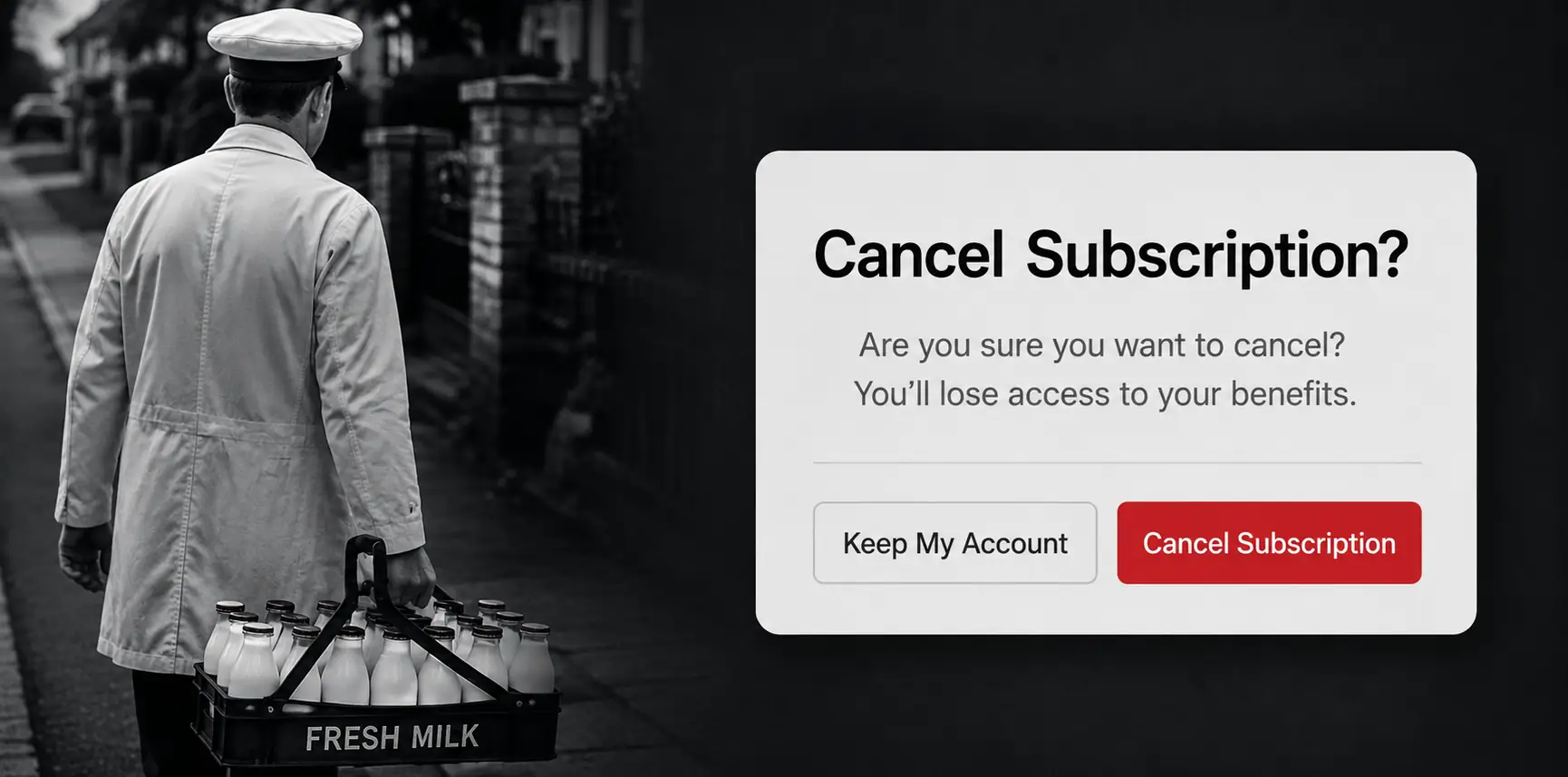
Like many people, I appreciate subscription services that are simple, convenient and transparent. If a company delivers a good service, I’ll happily remain a customer. If circumstances change, I expect cancelling to be just as straightforward as signing up.
Unfortunately, that wasn’t my experience with McQueen’s Dairies.
Signing up
I first signed up years ago on the doorstep. They just took my details and for a long time my order just got delivered and they took the money via direct debit.
More recently they were unable to deliver my order for a number of weeks and when I contacted them they could provide no details on when normal service would be resumed.
Given this left me having to go to the shops and facing an indefinite interruption to the service, I decided to cancel my subscription.
Cancel “any time”
McQueens advertises that you can “Cancel any time, no commitment” which sounds reassuring, but you don’t really find out until you try. I quickly discovered that wasn’t the experience I was about to have.
I tried to cancel online, and that didn’t seem possible. I could add and remove items to my order but getting it down to no delivery or cancelling altogether was impossible.
They offered a pause facility for holidays, so it’s not like they haven’t thought about this, and as such I can only conclude they have deliberately chosen not to provide a cancel feature.
No problem, I will just email support and ask them to cancel.
Rather than accepting my written cancellation, I was told they couldn’t process it that way. Instead, I had to book a callback with their customer care team. More concerning was the statement that if I didn’t answer the callback, my account would remain active.
The practical implication seemed clear:
- I was prevented from cancelling myself
- My written cancellation was refused
- I had to participate in a phone call
- If that phone call didn’t happen, my account would stay open
I re-read through the company’s published Terms and Conditions. I could find references to cancelling by phone, and contacting them via email etc, but there was little about the cancellation process, let alone the callback requirement.
At that point I decided not to engage with what felt like an unnecessary retention process. I again provided written notice and cancelled the Direct Debit.
That should have been the end of the matter. It wasn’t.
Continued billing
Despite my written cancellation and the account being closed, the company has continued attempting to take payments. When I contacted customer support to resolve the issue, yet again they told me they were unable to deal with it and I would have to call the credit control team.
Once again, the answer to a straightforward written enquiry was apparently another mandatory telephone conversation.
It’s difficult not to see a pattern emerging. It seems support are either unwilling or unable to deal with basic yet fundamental support enquiries and there is ridiculous friction, some of it clearly by design and intentional.
Regulations
UK consumer protection law increasingly recognises that businesses should not create unnecessary friction when consumers wish to exercise their rights and regulators are paying more attention to these kinds of dark patterns.
The Digital Markets, Competition and Consumers Act 2024 (DMCC Act) introduced a new framework governing unfair commercial practices and strengthened protections for consumers, including rules aimed at preventing subscription “traps” and making it easier to end ongoing contracts.
Alongside the Consumer Rights Act 2015, businesses are expected to deal with consumers fairly, provide clear information and avoid commercial practices that materially distort consumer decisions.
Practices that refuse to recognise clear written cancellation requests, require unnecessary additional steps, or make cancellation significantly harder than sign-up are exactly the sort of behaviours that regulators have indicated they are paying closer attention to.
Good businesses don’t need to make leaving difficult. They earn loyalty by providing a service customers want to continue using. They also join up key processes so that if someone cancels, the account is closed and billing ceases.
For me, what began as a routine cancellation turned into an unnecessarily frustrating experience involving repeated demands for telephone conversations, continued payment requests after cancellation, and a process that felt designed to create friction rather than solve problems.
Oversight
I’m not suggesting every inconvenient process is designed as such, but in the case of McQueens, I can reach no other conclusion.
In the UK, concerns about unfair consumer practices can be reported to the Citizens Advice Consumer Service, which acts as the gateway to Trading Standards in England and Wales. Trading Standards investigate businesses where there is evidence of potentially unfair or misleading practices affecting consumers.
The Competition and Markets Authority (CMA) also has strengthened powers under the Digital Markets, Competition and Consumers Act 2024 to investigate and enforce consumer protection law, particularly where practices appear to be widespread or form part of a company’s standard business process.
While neither organisation resolves individual contractual disputes in the way a court would, both are responsible for ensuring that businesses comply with consumer protection legislation and for taking action where systemic issues are identified.
Conclusion
If there is a lesson here, it is the usual one: read the terms before you sign up. Cancellation rights, billing rules and how to end a subscription should all be in writing, and you are better off knowing what you agreed to than finding out the hard way.
However, as in the case of McQueens, who advertised “cancel any time, no commitment”, the practical process looked nothing like the promise, and their published terms mentioned nothing of the real process and hurdles.
What was written was inaccurate, incomplete, or simply ignored once it became inconvenient, and so in this case knowing your rights and a firm hand is what is required.
And when such things happen, it is worth making Trading Standards and the Competition and Markets Authority aware of rogue traders.
Dan's Blog
Information Technology, programming, health, fitness and photography enthusiast.
- Not a writer.
- All views are my own.
- Offence is optional.
- Do your own research.