Digital Panopticon - Our Dystopian Future
Published : Saturday 4 July 2026
A world where technology tracks and controls every aspect of life ...
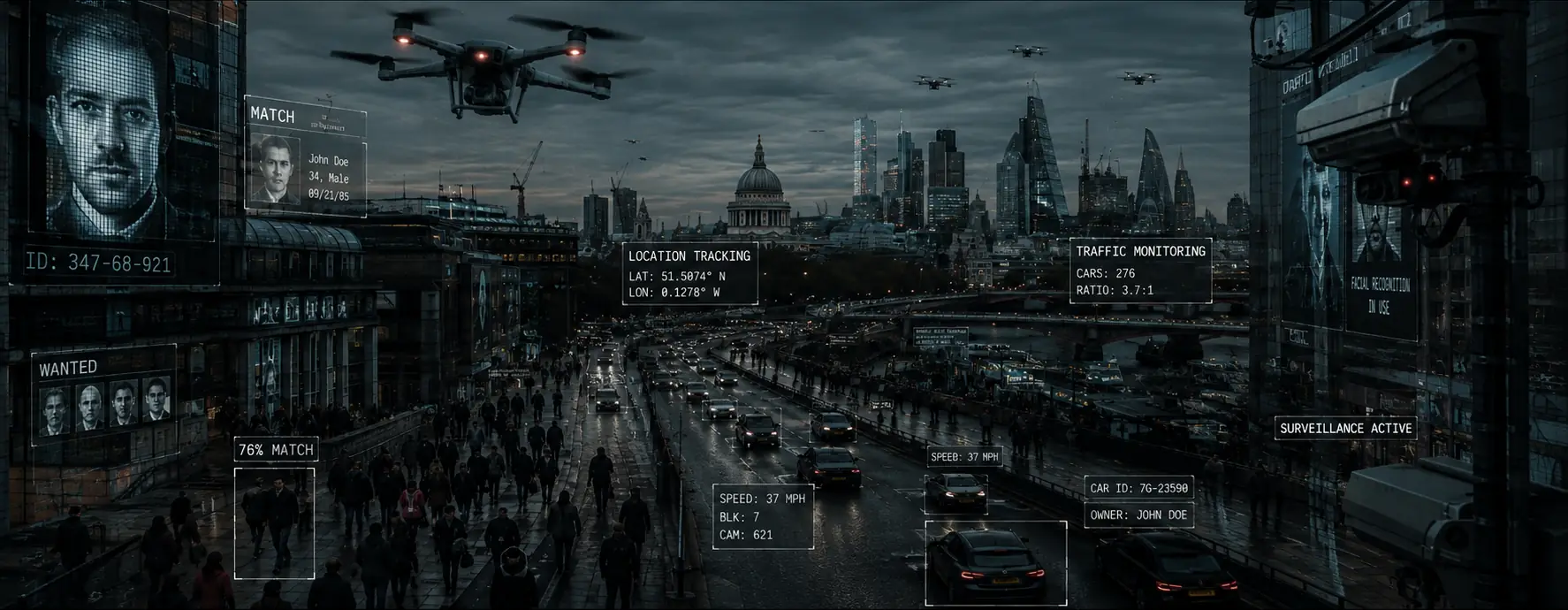
It’s evident that we are hurtling toward a world where technology isn’t just a utility to use, it tracks and controls every aspect of life.
That’s not to say technology is the enemy and we should all go live off-grid, but we should be very cautious about those who wield it, especially under the guise of “safety”.
Privacy advocates have been sounding the alarm for years: what starts as “security” or “safety” features often builds the infrastructure for unprecedented surveillance and centralized power. The pieces are falling into place … everywhere and everything, all interconnected, and opting out may soon not be an option.
In this blog I’ll outline what I see as the key pieces of the infrastructure for a “Total Control Technology Stack”.
Everything Online, Including Device Logins
Our lives have shifted almost entirely online. Banking, government services, shopping, “social” interaction, it’s all tied to digital identities. Device logins increasingly require cloud accounts, biometrics, or persistent tracking.
Phone and SIM registration already enable carriers and authorities to monitor movements and associations via identifiers such as IMEI and IMSI. Your operating system may add another layer. This creates a baseline of traceability that scales easily to broader systems.
Combine this with subscription culture where everything comes at a monthly fee… “you’ll own nothing and be happy”.
Digital ID: You, Your Face, Your Device
The push for “age verification, more accurately, digital ID is spreading fast across the West. Governments, banks, healthcare, social media, entertainment, gaming: privacy concerns be damned. You’ll be cornered into providing it, and once they have it, it’s tied to your accounts, movements, and transactions. Struggling through daily life without it becomes the point.
That ID is increasingly checked with biometrics, your face or fingerprint. Unlike a password, you can’t change your face if the database leaks or is abused. And the device in your pocket completes the lock: hardware chips (such as TPMs) can uniquely identify your phone or computer and prove to remote systems that it’s that machine, used by that person. Identity, body, and device glued together. Suddenly those evil tracking cookies sound like a tasty snack.
Locked-Down App Stores and the End of Sideloading
App stores from Apple and Google already curate what you can install, citing safety. Microsoft has been tightening its belt too, with notable apps like WireGuard, the backbone of many VPNs suspended recently on “procedural grounds”. A curious coincidences if nothing else.
Sideloading (installing apps outside the official store) faces increasing restrictions, remote attestation checks, or outright blocks on “unverified” sources. This turns your device into a walled garden where only approved software runs.
Innovation suffers, independent apps die, and control centralizes further. If the gatekeepers decide certain tools: VPNs, privacy browsers, encryption apps are a “safety issue”, they’re gone. You can no longer use your device outside what is pre-approved.
On-Device Content Screening: The Death of E2EE
You don’t need to break encryption if you scan the content before it gets encrypted. That’s client-side scanning: your phone analyses photos, messages, or files for “prohibited” content and can flag or report them. Apple proposed this for iCloud (then paused); similar ideas keep resurfacing in the EU (“Chat Control”), the UK, and elsewhere, always “for the children”.

(Click for full resolution)
Proponents say it’s “local only.” Once every device ships with the scanner, who updates the hash lists and models, and what gets flagged next? End-to-end encryption is theatre if the device snitches first. Unique devices, digital ID, locked app stores, and on-device scanning aren’t separate products; they’re a stack.
Public surveillance and monitoring
Overlay this with real-world eyes: ubiquitous CCTV with facial recognition, Automatic Number Plate Recognition (ANPR), and AI that turns footage into searchable tracks of where you, or your car have been. Systems like Flock networks in the US, and similar programmes in the UK, record, profile, and log everything at scale.
Low-power LoRa (and similar) networks quietly fill the gaps between the cameras: cheap sensors and trackers that don’t need Wi-Fi or a phone signal, used for everything from utilities to asset and people tracking. Combined with ANPR zones and live CCTV, the street itself becomes part of the stack watching whether you’re on foot, on a bike, or in a car.
Robotic and drone Surveillance
CCTV is everywhere, but as drone and robotic technology improves, mobile surveillance will become universal too, and those with power are just looking for opportunities to deploy their new-found capabilities.
During COVID, UK police used drones to shame dog walkers in remote areas like the Peak District, publicly shaming people for perfectly legal exercise.
It won’t be isolated to authorities. Companies have deployed drones for monitoring, surveillance, security, and more nefarious endeavours.
With greater automation and AI-driven enforcement, the opportunity to scale further with less human oversight will inevitably follow.
Smart Home Privacy Invasion
Even at home, you are not free. Already “Smart” home devices are often needlessly cloud-connected: TVs, doorbells, Alexa-style assistants, cameras create a sensor network inside and outside your house.
Post-purchase updates changing features, terms, and privacy policies is already something that happens and I have had personal experience with various devices including LG televisions. You must submit to their new and updated terms or they limit your device!
Features like Ring’s “Search Party” for lost pets already scan neighbourhood cameras with AI; an algorithm tweak could shift from dogs to people, and who knows what certain agencies already do behind the scenes.
Beyond this, meshing networks (LoRa, parts of 5G, and similar) can stitch these devices together and quietly work around conventional security perimeters. Your home stops being a private space and becomes another always-on node on the grid.
This rise in always-connected, always-on technology outside of our control allows governments to reach further and further into our lives and monitor and control what we do.
- Man locked out of smart home for a week after delivery driver accuses him of being racist
- Texas power companies automatically raised the temperature of customers’ smart thermostats in the middle of a heat wave
- Millions of households at risk of smart meter snooping
Personal Transport: Your Car Is Watching You Too
Modern cars are always-on computers on wheels. Location, speed, cabin sensors, much of it already phoning home. Features you used to own are becoming subscriptions, and remote immobilisers sold as theft protection are still kill switches: once every car can be soft-bricked over the air, who holds the API matters more than the marketing.
Europe is pushing this hard under “safety.” Intelligent Speed Assistance nags or cuts power when you exceed the limit; from July 2026, EU rules require driver-facing cameras watching your eyes for distraction. Officially local-only, same claim as on-device scanning, but the hardware is now standard, and US/UK markets tend to inherit the same stack.
Travel Monitoring and Restrictions
The car is one half of the problem; where you’re allowed to go is the other. Councils already experiment with “traffic management” via gates and permits, limited passes into zones, rationing movement. Further controls arrive under safety, environment, or an “emergency.”
Oxford’s proposed congestion charge, sold by operators themselves as a response to a “traffic emergency”, offers residents 100 free day passes for now. What happens when it’s 10, none, or you pay every time? What happens when other data decides eligibility? Nothing is immutable, and you’re handing control to people with a track record of abusing it.
AI, Profiling, and Automated Decisions
Hand all of this data to opaque systems and the next problem writes itself: decisions made about you, often without a human who will own the outcome. The Post Office Horizon scandal showed what happens when institutions trust the machine over the person: wrong data, wrong accusations, ruined lives, and a system that doubles down rather than admits error.
I’ve had personal examples: Incorrect or unexplained data shared across insurers affected me; getting it corrected meant fighting through Subject Access Requests, silence, and regulators who struggled to enforce basic rights. When profiling is automated and accountability is optional, “your rights” exist mainly on paper. Remove humans from the loop, even more than they already are, and once your card is marked, it might be game over.
Cashless Society: Digital Currency (CBDC)
Eliminate cash, and participation requires the system. No digital ID or compliant device? No transactions, no travel, no access. Convenience becomes coercion.
We’ve already seen “de-banking”: citizens denied basic banking services, sometimes due to anti-fraud flagging, but in some cases for holding particular views or opinions.
With Central Bank Digital Currencies (CBDCs), control goes further than de-banking. Unlike cash or even Bitcoin-style systems, a CBDC can be programmed: governments (and potentially employers) decide what you may spend, where, and when. It could even be made to expire.
At that point the stack is complete: your life monitored and controlled end to end.
Consolidation and Abuse of Power
These risks compound as power consolidates and your democratic vote counts for less. Across the UK, local councils merge or lose autonomy; decisions shift to national governments or international bodies (WHO, UN, EU, NGOs, etc.) with little accountability to citizens.
A single policy or “emergency” can cascade into rules you have, to all intents and purposes, zero say over. We saw the precedent during COVID: “just two weeks to flatten the curve” and again with open-ended “climate” emergencies: vague definitions, timescales, and outcomes that can mean whatever those in charge want them to mean.
“Nothing to Hide”? History Says Otherwise
The common retort: “If you’ve got nothing to hide, you’ve got nothing to fear.” This ignores how power shifts. Hitler was democratically elected in 1933 with significant popular support. Seemingly innocuous tools census data on religion, tax records, community lists helped authorities systematically identify and target Jews under the Nuremberg Laws’ racial definitions.
This wasn’t ancient history; it was within living memory. Similar dynamics play out today in places like China (social credit, Xinjiang surveillance) and North Korea. Democracies aren’t immune: regimes change, crises arise, and “temporary” measures stick. Data collected for safety or efficiency rarely stays in its lane.
Breach, Theft, and Compromised Gatekeepers
So far this has been about what is done in plain sight: laws bent, “safety” sold, opt-outs removed.
What we learnt through the Edward Snowden leaks is that governments have eyes and ears everywhere, deeply intertwined with technology corporations. Emails, chats, videos, photos, file transfers, social networking details, VoIP calls, and more. Do you think they have stopped there?
Once the data is collected, those systems become a honeypot, and valuable targets for criminals, hostile states, or insiders. Whether targeting individuals or bulk data, these systems prove to be vulnerable time and time again to data leaks and hacking.
- Security concerns over system at heart of digital ID
- Security tests reveal serious vulnerability in government’s One Login digital ID system
You are asked to trust the vault with everything. Vaults get cracked. When they do, the blast radius is no longer just a password reset, it is your entire digital life.
You may have been locked out of your life, even jailed, long before it comes to light.
Technology Isn’t the Villain
Technology itself can be liberating: better tools, knowledge, efficiency. The danger lies in handing vast troves of data, identification, and control to centralized authorities, whether governments or a handful of corporations.
History shows that by the time most people recognize the full scope of the problem, resistance becomes extremely difficult. Revolutions have sometimes reset the balance, but they are unpredictable, and often lead to new forms of control.
Prevention through decentralization, open-source alternatives, strong encryption, and cultural pushback for privacy is far preferable, but even then, regulators try to capture these.
We don’t need to reject tech. We need to reject the assumption that centralization of power and control equals progress or “safety”.
We should be demanding that regulations require:
- Open standards
- Interoperability
- Local processing
- The right to sideload
- Privacy transparency and guarantees
- Strict limits on remote surveillance and control
- Guarantees about lifetime product features, terms and privacy.
Further more, regulating bodies must operate independently, openly, and in the public domain, not behind closed doors, funded by those they regulate.
The future isn’t necessarily inevitable yet, but we are long down the road and need a radical course correction.
Dan's Blog
Information Technology, programming, health, fitness and photography enthusiast.
- Not a writer.
- All views are my own.
- Offence is optional.
- Do your own research.